A wedding dress size is not the same as your clothing size. Bridal sizing runs roughly two to four sizes smaller than street sizing, which means a woman who wears a UK 10 will often fit a bridal 14. This is not vanity sizing and it is not a mistake — it comes from a sizing system built in the 1940s and never revised.
Understanding it before your first appointment removes the single most common source of distress in a bridal fitting.
Why is a wedding dress size different from my street size?
Bridal sizing was standardised in the 1940s and 1950s, based on measurements of women in that era. Ready-to-wear clothing has been re-graded many times since; bridal has not. The result is a persistent gap of two to four sizes between the two systems.
The number on the label is a manufacturing reference, not a judgement. It is used to select the closest pattern block, which is then altered. Nothing about it reflects the dress code you wear, and no atelier treats it as a measurement of anything except fabric.
How is a wedding dress measured?
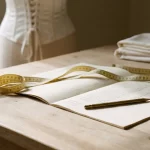
Bridal sizing uses four measurement points, plus one length measurement for the gown.
| Measurement | Where it is taken | Why it matters |
|---|---|---|
| Bust | Around the fullest part, tape level and parallel to the floor | Governs the bodice pattern block |
| Waist | At the narrowest point of the torso | Governs the skirt and waist seam |
| Hips | 20 cm below the waist, around the fullest point | Governs fitted silhouettes |
| Hollow to hem | From the hollow at the base of the throat, straight down to the hem | Governs gown length — not your height |
What is hollow to hem?
Hollow to hem is the length from the small dip at the base of your throat, between the collarbones, straight down the front of the body to where the hem should fall. It is measured with your wedding shoes on.
It is not your height. Two brides of the same height can need different gown lengths because of torso length and heel height. This is why a made-to-order gown asks for hollow to hem rather than “tall” or “petite”.
Should I order to my largest measurement?
Yes. Always order to the largest of your four measurements, then take in the rest.
A gown can be taken in; it can rarely be let out by more than one size, because the seam allowances were never cut for it. Ordering to a smaller measurement to feel better about the number is the single most common mistake in bridal ordering – and it is expensive to fix.
What if I fall between two sizes?
Order the larger size. A gown that is slightly too big can be fitted precisely; a gown that is slightly too small cannot. The alteration cost difference is small. The risk difference is not.
In a made-to-order gown this question disappears entirely — the pattern is cut to your measurements rather than a size, so there is no size to choose.
Does size matter if the dress is made to order?
Only as a starting reference. In a made-to-order or couture gown, the atelier takes your measurements and cuts a pattern to them. The size number becomes irrelevant; what matters is the measurement set and the number of fittings.
This is one of the practical advantages of a made-to-order atelier over a boutique that sells standard sizing. There is no “closest size” — there is your pattern.
What is the fitting difference between sizes?
A gown cut to a standard size assumes an average proportion. Real bodies are rarely average: a bride may have a small waist and a fuller hip, or a long torso and narrow shoulders.
The alterations needed depend entirely on where your measurements diverge from the block:
- Bust larger than block — bodice let out or re-cut
- Waist smaller than block — waist seam taken in, which can shift the skirt
- Hips larger than block — limited by seam allowance, may need a re-cut
- Short torso — waist seam raised; this changes the proportion of the whole gown
- Long torso — waist seam lowered; often needs a new pattern rather than an alteration
Anything involving the waist seam is more than a fitting adjustment. This is the reason made-to-order exists.
What to bring to a measurement appointment
- The shoes you will wear, or the exact heel height
- The undergarments you plan to wear on the day
- A hair tie if you have long hair — it affects the neckline reading
- Nothing else. Shapewear worn on the day of measuring will change the measurement
Common mistakes
Ordering a size down to lose weight before the wedding. Alterations can take a gown in by one to two sizes safely. Beyond that, the proportions break and the cost rises sharply.
Measuring without shoes. Hollow to hem without the correct heel height produces a gown of the wrong length. This is unfixable if the hem is cut short.
Using a home size chart instead of the atelier’s form. Every manufacturer’s chart differs. Use the one provided by the atelier making your gown.
Assuming you are the same size in every label. A bridal 12 in one house is not the same as a bridal 12 in another. Measurements are comparable; size numbers are not.
Frequently asked questions
Is a wedding dress size the same as a UK size?
No. Bridal sizing typically runs two to four sizes larger. A UK 10 usually fits a bridal 14.
How many sizes can a wedding dress be taken in?
One to two sizes safely. Beyond two sizes, the balance of the gown changes and the cost of alteration approaches the cost of ordering correctly.
Do you measure with or without shoes?
Hollow to hem is measured with your wedding shoes on, or with the exact heel height accounted for.
What is the most important measurement for a wedding dress?
The bust, because it governs the bodice block, and hollow to hem, because it cannot be corrected upward if cut short.
Can a wedding dress be made bigger?
Rarely by more than one size. Seam allowances limit how much a gown can be let out, and some fabrics — beaded or heavily embroidered — cannot be let out at all without visible marks.