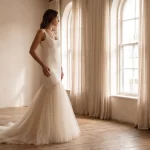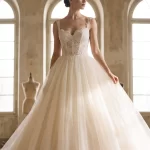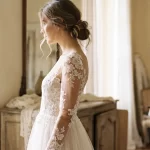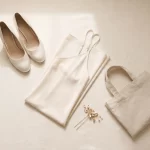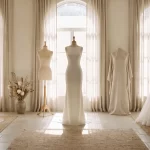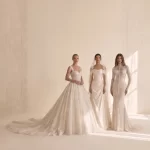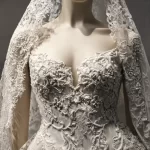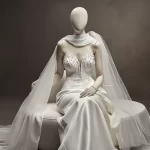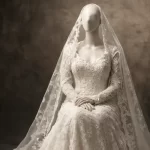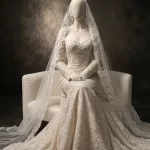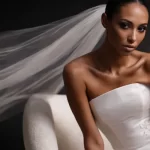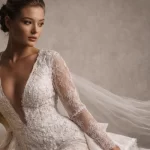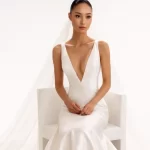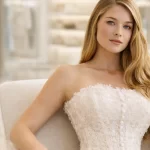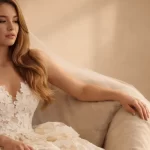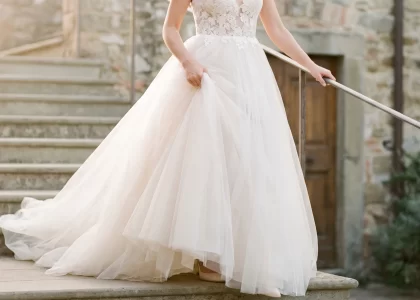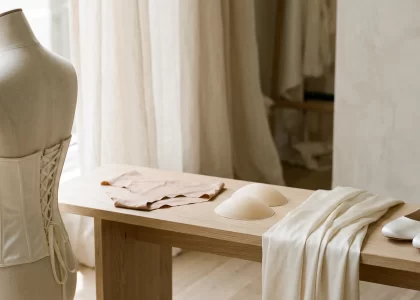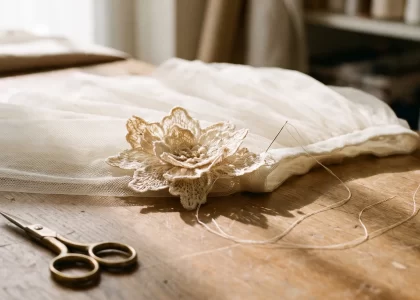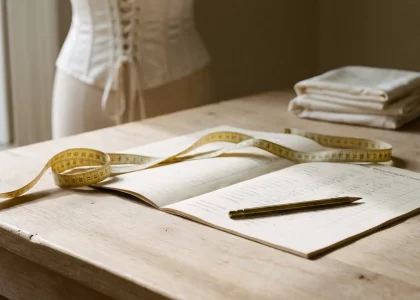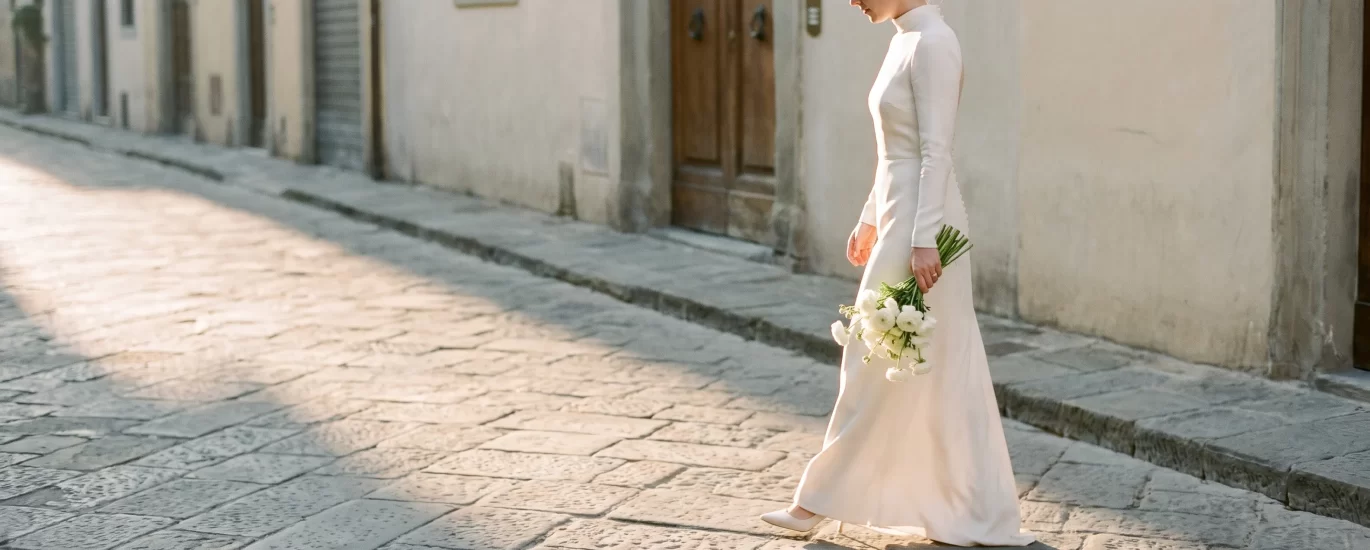
An elopement wedding dress is designed for a different set of conditions than a large-wedding gown. There is no aisle to walk, no audience to read from a distance, and no bridal party to manage a train. What matters instead is movement, closeness and how the gown reads in photographs taken at two metres rather than twenty.
The result is not a simpler dress. It is a dress built on different priorities.
What is an elopement wedding dress?
An elopement dress is a gown chosen for a wedding with few or no guests, usually in a non-traditional venue — a registry office, a city street, a landscape, a restaurant. The term covers everything from a two-person ceremony to a small gathering of fifteen.
The practical difference is that the gown is seen up close and in motion rather than from a distance and standing still.
How does it differ from a large-wedding gown?
| Factor | Large wedding | Elopement |
|---|---|---|
| Viewing distance | 5–30 metres | 1–3 metres |
| Dominant impression | Silhouette and volume | Fabric, detail, movement |
| Train | Statement, often long | Practical, often short or detachable |
| Skirt volume | Often full | Usually column, sheath or soft A-line |
| Detail level | Reads at distance | Reads at arm’s length |
| Transport | Car, venue, one location | Walking, transit, several locations |
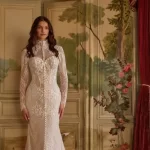
The single biggest shift is that fabric quality becomes visible. In a large venue, a gown is judged by its shape. Up close, it is judged by how the silk falls and how the seams are finished.
Which silhouettes work best?
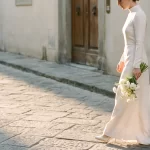
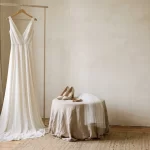
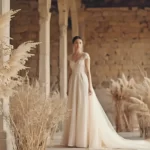
- Column and sheath — the strongest choice. Clean line, easy to walk in, photographs beautifully close up.
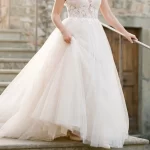
- Soft A-line — works if the skirt is in a single light layer; fuller skirts look disproportionate in a small room.
- Slip dress with a bias cut — excellent for a registry office or restaurant, and easy to wear all day.
- Tea-length — practical, charming, and increasingly common for city ceremonies.
- Mermaid — works if you are comfortable walking in it; it restricts stride length, which matters if you are moving between locations on foot.
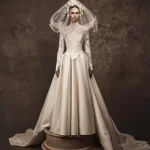
Avoid full ball gowns unless the venue specifically carries the scale — a cathedral or a grand hall can take one. A registry office cannot.
Which fabrics work best?
Fabric matters more here than in a large wedding, because it is what people actually see.
- Silk crepe — the best overall. Falls cleanly, does not crease badly, photographs with depth.
- Bias-cut satin — beautiful in motion, unforgiving in fit, excellent for evening ceremonies.
- Light tulle over a fitted base — adds softness without bulk.
- Chiffon — cool and light, good for warm climates and outdoor ceremonies.
- Heavy beading — avoid. It photographs as texture rather than detail at close range and adds weight for no gain.
Why movement matters more than volume
In an elopement, the gown is in motion most of the day: walking streets, climbing steps, sitting in a restaurant, getting into a car. A gown that photographs well standing still but restricts walking is the wrong gown.
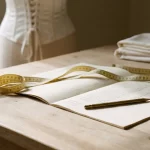
Test this at the fitting. Walk the length of the room, sit down, stand up, and go up and down a flight of stairs. If any of those is difficult, the gown is wrong regardless of how it looks.
What photographs to plan for
Close-range photographs are the whole record of the day. Plan for:
- Three-quarter and close crops — the fabric and the neckline carry the image
- Movement shots — walking, turning, a hand on a railing
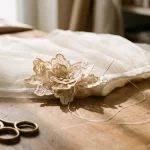
- Detail shots — the closure, the sleeve, the hem, the shoes
- A single wide shot — for context, not for the dress
This is the opposite of large-wedding photography, where the wide shot does most of the work.
Ordering with a short lead time
Elopements are often planned in three to six months. A made-to-order gown can still work, but the schedule is tighter.
- 6 months out — order, choosing a silhouette with a simpler construction
- 4 months out — first fitting
- 6 weeks out — final fitting
- 2 weeks out — collect, press, pack
What compresses well: a column or sheath in a single fabric with minimal handwork. What does not: heavy appliqué, extensive beading, or a skirt in multiple layers.
If your timeline is under three months, ask the atelier directly what is achievable. Many will take on a simpler gown on a short timeline and decline a complex one — which is useful information, not a rejection.
What to skip
- A long train — nothing to manage it, and it will be dirty within an hour
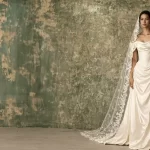
- A cathedral veil — no aisle, and it will not survive outdoor conditions
- A heavy hoop or crinoline — makes sitting and walking difficult
- A second look — with a small guest list there is no reception to change for
- Matching bridesmaid considerations — there are no bridesmaids to coordinate with
Frequently asked questions
What should you wear to an elopement?
A column, sheath or slip dress in silk crepe or bias-cut satin works best. The priorities are movement, fabric quality and how the gown reads at close range.
Can you wear a ball gown to an elopement?
Yes, if the venue carries the scale – a cathedral, a grand hall, a formal restaurant. In a registry office or outdoors, a ball gown looks disproportionate.
Do you need a train for an elopement?
No. A short train or no train at all is more practical, and there is no aisle to display a long one.
How far in advance should you order an elopement dress?
Six months is comfortable. Three months is workable with a simpler silhouette and minimal handwork.
Is a short dress appropriate for an elopement?
Yes. Tea-length and midi dresses are common for city ceremonies and photograph well at close range.